Tuesday, March 25, 2008

The Thrill of the Chase

Do sporting men hunt because of an inferiority complex? My opinion, according to what I read in Ritvo, is yes. In the thrill of the chase, fallen animals are talked about like trophies, and I think that men in this context hunt because they are trying to impress other men, or elevate their status. After a quick lamentation over a fallen animal, “The sympathy evinced by such responses, was, however, skin deep. The fallen animal soon resumed its status as an object, and the hunter as quickly prepared to fire again” (267). Hunters were seen by other hunters in “a heroic light” (266) and their killings were celebrated. Personal physique was also a big part of a hunter, “The best sport required the hunter to prove his physical mettle—to overcome a dangerous and powerful animal on its own terms. As a result, the fiercest opponents were often also the most attractive” (268). Men who felt inferior would most likely build up their strength and stamina for a big hunt so that they could “prove” their worth and not look pathetic in the eyes of other hunters.
It doesn't seem right to kill something this huge (in my opinion)

Secondly, in class the subject of how certain people reacted to eating meat was brought up. A lot of people are against animal cruelty and think that the caging of animals and their slaughter is horrific, but they still eat meat and prefer not to know how their meal was killed. Ritvo states, “The uncompromisingly physical nature of this domination was underscored by the two most frequently emphasized features of the climactic scene: a precise anatomical and ballistic analysis of how the kill was accomplished and a sentimentalized description of how the animal faced its demise” (265). I think that if every box of chicken mcnuggets you eat had the story of where the chicken was killed and how it struggled, you would think twice about eating what was in front of you.

This man is using his kill as a trophy, and I'm sure bragged about his "huge success" in order to compensate for other things...

I am not completely against hunting, but I think that certain people, men in particular, hunt because they think that they will be thought higher of by other men in the same circle if they are more skilled at hunting. I know certain people who quail hunt just for sport, and don’t even collect the birds they kill, they just like to see the bird fall from the sky. In my opinion, if you are going to kill an animal at least do something with the body, like eat it or use it for something. Don’t make its’ life completely meaningless.

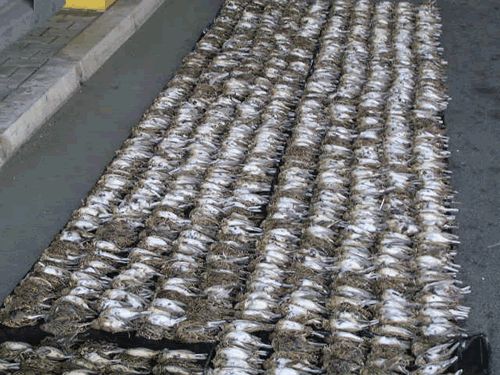
This seems like a massacre...
Monday, March 3, 2008

Littlefield


Victorian House

Victorian Town Hall, Manchester

I think it is so weird how Victorian architecture can encompass so many things: flying buttresses, dragons, lions, red brick and stone, etc. The Littlefield house, on the corner of 24th and Whitis is an example of Victorian Architecture and its’ elements.
The gothic elements are represented throughout the house both in the interior and on the exterior. In Ruskin’s “The Stones of Venice” he talked about the six elements of gothic, which I will relate to the house.
1) Savageness or Rudeness: the Littlefield House may seem perfectly put together, but the “roughness of work” [1] and “the imperfection of the workman” [2] are shown in the laying of the brick and the attempt but not complete success of perfection.
2) Love of change: I think the love of change is the most prominent feature of the house. If you look at the layers, you see different iron gates, and columns that are asymmetrical, but the whole thing fits together. The layers of the balconies aren’t the exact same, and the materials even change throughout: red brick, stone, greenish iron, white columns. The love of change exhibits the “perpetual variety of every feature of the building…. great art, whether expressing itself in words, colours, or stones, does not say the same thing over and over again. To me, the change says that they welcomed variety and new ideas. Also, the shapes of the rooms on the interior are not similar to each other—one room has a circular attachment that serves little purpose.
3) Love of nature: The fences around the balconies are shaped like vines with leaves and the tiles on the top towers look like leaves. The top of the towers have tree looking things that seem to have leaves dripping off of them.
4) Disturbed imagination: The inside has the gargoyle dragons in the front room on top of the fireplace, and the top of the outside has lions heads on them.
5) Obstinacy or Rigidity: The outside, especially the top, seems very prickly and juts out at you at certain places. The top spikes of the towers project upward and look very sharp.
6) Generosity: The space between the two floors seems very large, and there is so much space that has been filled. Each detail of the exterior shows so much craftsmanship and hard work, and you can tell that there was so much labor and thought put into its’ design. Look at the space between the two floors:

[1] Anthology, 535.
[2] Anthology, 535.

Black Beauty 1

The first page of Black Beauty invokes memories of childhood and allows the reader to sympathize with Black Beauty within sentences because the first person account makes him seem human, “While I was young I lived upon my mother’s milk, as I could not eat grass. In the daytime I ran by her side, and at night I lay down close to her.” [1] If I were writing an autobiography (assuming I could remember my first few days of infancy) a sentence would similarly read: “While I was young I lived upon my mother’s milk, as I could not eat solid food. In the daytime she held me by her side, and at night I lay close to her in my crib.” The parallel between a horse’s infancy and a child’s is undeniable, as it is with many animals. Sewell calls to the reader’s sympathetic imagination from the start, perhaps because Sewell was crippled at a young age and knew what it was like to be hurt and unable to function like her peers. The way Black Beauty’s mom talks to him is exactly like my mother would talk to me when I was in with the wrong crowd or misbehaving: “You have been well bred and well born; your father has a great name in these parts, and you grandfather won the cup two years at the Newmarket races; your grandmother had the sweetest temper of any horse I ever knew, and I think you have never seen me kick or bite. I hope you will grow up gentle and good…”[2] When I got a ticket in high school, my parents would reprimand me telling me “You know better, Caroline. Now everyone is going to be talking about you, and assume we aren’t doing a good job.” Harsh.

The notion of confusion is also a universal one. In the chapter “The Fire” Black Beauty wakes up and is confused by the uncomfortable feeling caused by the smoke, and “I did not know what it was, but there was something in the sound so strange that it made me tremble all over.”[3] I have had the same feeling, but instead of a fire it was a tornado: I was Lake Texoma with my family and I woke up to an unfamiliar jolt and a flash of lights, then complete darkness. I couldn’t see anything, but my entire body shook from fear. The feeling of confusion and fear is something that is experienced by all, and should help us make the sympathetic connection with animals.


When Reuben is killed, there is an inquest held, and Black Beauty is “put on trial” and cleared of blame, just like a human would be put on trial and charged or set free. The first person nature of Black Beauty makes the reader sympathize more with him because it seems like you are reading the autobiography of a peer, and can relate to so many of his stories. I think this makes is more interesting to read and easier to read because the audience is held more captivated by the similar experiences.

[1] Sewell, 3.
[2] Sewell, 4.
[3] Sewell, 60.

Ritvo, A Measure of Compassion

“They were surrounded by evidence to the contrary in a society that exploited animals to provide not only food and clothing, but also transportation, the power to run machinery, and even entertainment.”[1]
Rodeo.
Furs.
Tours at the Grand Canyon.

What has changed besides less of a need for the power to run machinery? Not much. Horses that are hurt or too old are shot, people flock to rodeos every year (especially in Texas) to watch men wrestle sheep, or bring a bull down by its’ horns, furs are worn by those who consider them fashionable. To me, it seems that we have reverted back to the ways of the English in 1800. Our two cultures have so many similarities, especially within the first few pages of A Measure of Compassion. The idea of having laws against animal cruelty were not accepted at the beginning of the 19th century, but within 21 years opinions changed and laws were passed and publicized greatly: “Capitalizing on this increased interest in humane issues, the society distributed twenty-five thousand abstracts of the new law during the next year.” [2]

By the late 1800’s I believe that the fact that “a humanitarian crusader could celebrate the fact that ‘to an increasing part of the race, especially in Anglo-Saxon countries, this sentiment of tenderness for those of the sentient lower creatures which are capable of recognising [sic] it… has become an element in the spiritual life so strong that the continual violation of social obligations to them is a cause of pain and revolt” [3] has a strong tie with our definition of sympathy which states that sympathy is “the quality or state of being affected by the condition of another with a feeling similar or corresponding to that of the other.”[4] This especially goes with the fact that “he was strongly encouraged by the spectacle of squirrels begging confidently for food in public parks, rather than fleeing from feared torture.” [5] This connects directly with the idea of the sympathetic imagination because he (in this case I was confused on who the he was…is it Drummond, or a general he??) puts himself in the imagination of the squirrel, and perhaps he would have feared getting tortured by the humans, but the squirrels brave it out because of their need for food. If the definition of sympathetic imagination is “the ability of a person to penetrate the barrier which space puts between him and his object”[6] then he penetrates the barrier of human into rodent and the space of the two is nonexistent—he becomes the squirrel for an instant and takes pity.

Morality is the biggest part of animal rights, in my opinion. In "The Principles of Animals' Rights" Henry Salt writes, "Legislation is the record, the register, of the moral sense of the community; it follows, not precedes, the development of that moral sense, but nevertheless in its turn reacts on it, strengthens it, and secures it against the danger of retrocession. It is well that society should proclaim, formally and decisively, its abhorrence of certain practices ; and I do not think it can be doubted, by those who have studied the history of the movement, that…animals would be infinitely worse at this day but for…progressive and punitive legislation" which I believe goes hand in hand with the justification of punishing society for animal cruelty. I do, however, think that what is right and wrong is so hard to establish because of the differing religions and view of society.

The part where Ritvo describes the use of animals as transportation seemed like the use of animals as slaves. "The reports included many accounts of donkeys beaten either by their drivers, 'human brutes,' or by the 'heavy men and women' who paid to ride them" (139). Many times, there were so many animals used as transportation that seemed unnecessary. For some reason, the amount of animals used to transport connected in my mind to the scene in "300" where Xerxes is carried on an overly heavy platform by many slaves; although he is not a particularly overweight man, the platform is obviously too heavy for the slaves carrying him, just as the men, women, and cargo was too heavy for the animals used to transport them in the mid-1800's as described by Ritvo.

He treats the men like stairs, walking down their backs with no concern to their well-being, just as the men and women abused the animals, beating them with "severe blows" or "repeatedly pulled pieces of the wool from its back" (139).
The flip flop between opinions concerning animal cruelty are much like today’s: laws were approved in the mid-1820’s to 1830’s, then all of the sudden “every attempt to extend humane legislation encountered resistance and even ridicule, despite the abundant success of previous laws.”[7] I feel like this connects with today’s society because one minute someone is a vegetarian, saying that it is so cruel to eat meat, then the next day they abandon their principles for a juicy burger. I have changed my mind several times in the past week in our class discussion because each side has a valid point. (NOTE: I am not saying that I love killing animals, but I think everything has its purpose, and eventually worms will eat my decomposing body, then they will die, fertilize the soil, which helps the grass grow, which feeds the cow, which feeds me…) I am a firm circle of life believer. I do believe that a lot of people have certain eating habits because they are practicing self-control. Blake said in class that his “vegan-ism” didn’t so much have to do with animal cruelty as it did with the satisfaction of having such power and control over what he put into his body. Ritvo writes about self control and the relationship between the treatment of animals and humans, particularly children: “Thus the need to be kind to animals provided the occasions to exercise self-control, and children who refused to take advantage of these opportunities were seen as likely to grow up to be dangerous to themselves and other humans.”[8] Does that mean that they would have considered kids who do rodeo and wrestle baby cows then go eat a steak a threat to humanity?

Is this kid a threat to the rest of humanity?


Here is part or Lord Erskine's speech from when he presented his bull for "Preventing Wanton and Malicious Cruelty to Animals."
"Their freedom and enjoyments, when they cease to be consistent with our just dominion and enjoyments, can be no part of their natures ; but whilst they are consistent, their rights, subservient as they are, ought to be as sacred as our own ... Every other branch of our duties, when subject to frequent violation, has been recognised and inculcated by our laws, and the breaches of them repressed by punishments ; and why not in this, where our duties are so important, so universally extended, and the breaches of them so frequent and so abominable ?…The next generation will feel, in the first dawn of their ideas, the august relation they stand in to the lower world, and the trust which their station in the universe imposes on them ; and it will not be left to a future Sterne to remind us, when we put aside even a harmless insect, that the world is large enough for both. This extension of benevolence to objects beneath us, become habitual by a sense of duty inculcated by law, will reflect back upon our sympathies for one another ; so that I may venture to say firmly to your Lordships, that the Bill I propose to you, if it shall receive the sanction of Parliament, will not only be an honour to the country, but an era in the history of the world" [9].

[1] Ritvo, 125.
[2] Ritvo, 128.
[3] Ritvo, 126.
[4] Sympathy Printout
[5] Ritvo, 126.
[6] Sympathetic Imagination Printout
[7] Ritvo, 128.
[8] Ritvo, 132.
[9] http://www.animalrightshistory.org/timeline/animal-rights-law.htm

Wednesday, February 20, 2008

Sympathy...

Austin as my Oxford...
When Hopkins writes about how “his love for the city grows more ‘sweet familiar’ with each passing term,” (633) I couldn’t help but think of my time in Austin. I came here three years ago and was overwhelmed by the “crowdedness” and mass of people all around campus and Austin. The traffic was horrible, both on foot and in a car, but as the semesters passed, I found ways to avoid the traffic and explore on foot both the campus and the city. There are so many buildings to be explored and looked at and I can relate to Hopkins in his increasing love for the buildings and surroundings of Oxford, or in my case, Austin and UT.

The aesthetics of colleges seem to be becoming less important—as noted by the RTF building, a modern abomination, and there are less and less Victorian structures that are highlighted. When Butler looks at the buildings and contemplates faith, he says, “Nothing remains but Beauty” (633), which reminded me of on of my favorite poems by Dickenson.
I DIED for beauty, but was scarce
Adjusted in the tomb,
When one who died for truth was lain
In an adjoining room.

He questioned softly why I failed?
“For beauty,” I replied.
“And I for truth,—the two are one;
We brethren are,” he said.

And so, as kinsmen met a night,
We talked between the rooms,
Until the moss had reached our lips,
And covered up our names.

There are so many references to the destruction of nature in Hopkins' writing, and the poem about cutting down the trees is one that is still important.


"Be a good boy, remember; and be kind to animals and birds, and read all you can." (Jude) This quote goes with sympathy, I think, because one of the definitions of sympathy from the printouts was, “Conformity of feelings, inclinations, or temperament, which makes persons agreeable to each other, community of feeling; harmony of disposition.” The cruel treatment of animals is a subject that is so important today, and like Smith says, "we have no immediate experience of what other men feel, we can form no idea of the manner in which they are affected, but by conceiving what we ourselves should feel in the like situation" (handout). If this is true for man, why is it not also true for animals. They have similar reproductive and nervous systems, so why do we figure they are without feelings. One of the things that disgusts me most is the exploitation of animals for fights or pharmaceutical testing and other things like the following video shows, so if you have a week stomach, do not watch...

Monday, February 18, 2008

Patterns of Conversion

Thirst for experience and the purpose of this class….

The search for the infinite and the thirst for experience directly relates to Alice and our college experiences.. When Alice takes a bite of the mushroom, she is curisous to know what will happen to her if she takes another bite of the other side—this constant search for experience and knowledge is the quintessential college experience. We are constantly biting new mushrooms, trying new classes, going to different rallies, etc to find out what our place is exactly or to figure out who we are. Like Tennyson, we participate in these outside experiences sometimes to cover up our pain. “the solution to a deeply personal problem was endemic to much verse.” (593)—we often join causes to distract us from problems. I know that when something is wrong with me, I choose to dive into a new project or book to take my mind off of the subject at hand. I agree with Browining when he says, “the fulfillement of desire meant spirtual death, for it removed the hhigh remote ideal that had giben motive power to the soul” (593). We can never be truly satisfied with how much we know, and when our desire for knowledge dries up, we are basically dead because if you aren’t learning anything new, what are you doing. This class is one where you are constantly thinking about what is next, what is behind you and what you are currently reading. I have yet to fully understand a text, and I am constantly going back to previous reading, and looking forward to what we will be reading about next to see what can be applied.

This class is also about getting over your fears—whether they be speaking in public, time management, computers, etc. There is like this thin film of fear that surrounds the class—you don’t want to be called on and not know the answer, or stutter or say something stupid, so you are forced to stay on task and keep up with your reading. Most classes should have this type of structure, but few do because the teachers lack authority.
]" width="400" height="326">]" />
When I read what Carlyle said about happiness in The Patterns of Conversion, “the source of a man’s blessed Unhappiness in the permanent desire for the Infinite which could never be quite submerged in the depths of the Finite” (594) I couldn’t help but think of Jude’s constant search for happiness in others. His unhappiness was derived out of the fact that he looked for happiness through other people—happiness must be found within yourself, or it will be a failure. If an artist/person is constantly looking for happiness and perfection in others, than they will fail, and to truly succeed and be happy, Ruskin says, “the demand for perfection, for the perfect finish, rather than the lovely for, was always a sign of the misunderstanding of the ends of art; for the great artist never stopped working till he had reached his point of failure.” (594). If you are going to fail, fail because you worked until you know you can’t anytmore, because “imperfection was [is] in some sort essential to all we know of life” (594).

]" width="400" height="326">]" />

Monday, February 11, 2008

Alice--If you are looking to peer review, see the next two posts

Going back to my roadmap, I just have to bring up the topic of everyone being in such a hurry.

Will you walk a little faster?"
Said a whiting to a snail,
"There's a porpoise close behind us,
And he's treading on my tail.
See how eagerly the lobsters
And the turtles all advance!
They are waiting on the shingle -
Will you come and join the dance?
Will you, won't you, will you,
Won't you, will you join the dance?
Will you, won't you, will you,
Won't you, won't you join the dance?


I feel like my parents are the ones treading on my tail--not that I am angry about it, but it may take more than four years for me to learn everything I want here. I have had some experiences, but I feel I have only eaten off one side of the mushroom. I have been the person watching and now that I have fallen into the rabbit hole, I am ready to dance and partake, and that might take me more than a year more, so they will have to learn (and hopefully fund).
I'm in a hurry to get things done
Oh I rush and rush until life's no fun
All I really gotta do is live and die
But I'm in a hurry and don't know why

Don't know why I have to drive so fast
My car has nothing to prove
It's not new
But it'll do zero to sixty in five point two

I'm in a hurry to get things done
Oh I rush and rush until life's no fun
All I really gotta do is live and die
But I'm in a hurry and don't know why

Can't be late, I leave in plenty of time
Shakin' hands with the clock
I can't stop
I'm on a roll and I'm ready to rock

I'm in a hurry to get things done
Oh I rush and rush until life's no fun
All I really gotta do is live and die
But I'm in a hurry and don't know why

Oh, I hear a voice
That says I'm running behind
Better pick up my pace
It's a race and there ain't no room for someone in second place

I'm in a hurry to get things done
Oh I rush and rush until life's no fun
All I really gotta do is live and die
But I'm in a hurry and don't know why -Alabama "I'm in a hurry."

Alice says that in her country, running fast leads you to where you are going, but I agree more with the Queen when she says, "Now, here, you see, it takes all the running you can do, to keep in the same place" (165). Sometimes, with the mountain of homework, tests and projects I feel like no matter how fast and how far I run, I end up further behind that when I started.
I get so tired sometimes that I give up, and that sets me back even further. Some nights I study for hours, and the next morning I cannot recall anything I had learned. Alice encounters the same problem when she meets the Caterpillar and cannot remember anything. "I ca'n't remember things I used--and I don't keep the same size for ten minutes together" (49). (Sidenote--freshman year I too could not keep the same size for ten minutes--I got pretty chubby...)
(I had a pillow in my stomach but still...)

Long story short, we are Alice's because college is just one big well waiting to swallow us all. You have to find your own way out...If you want out at all

]" width="400" height="326">